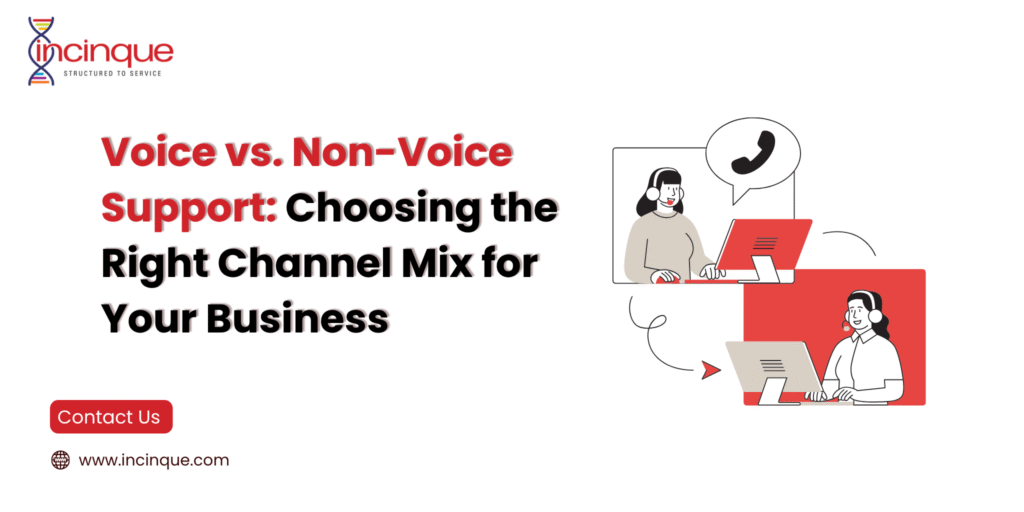
Voice vs. Non-Voice Support: Choosing the Right Channel Mix for Your Business
Every business reaches a point where “just have them call us” stops being a complete answer. Customers are contacting you through too many different places, expecting too many different things, and your support team can only handle so much before something slips.
The voice vs. non-voice conversation comes up at that point, and it usually starts with someone saying “can’t we just do chat instead of calls?” The honest answer is more nuanced than yes or no.
What Voice Support Actually Is (and Isn’t)
Voice support means phone calls. A customer calls, a human answers, the issue gets discussed and ideally resolved in real time.
It’s immediate. It handles complex situations well, the ones where typing out a problem would take ten minutes but explaining it takes two. It’s also what many customers default to when they’re frustrated, because there’s something about speaking to a person that email and chat can’t fully replicate.
The limitations are real too. Phone support doesn’t scale cheaply. Each call requires one agent’s full attention for its entire duration. There’s no parallel handling, one agent, one call. Peak volume periods create queues, and queues create unhappy customers before anyone’s even spoken to them.
For businesses dealing with high-stakes situations, financial disputes, medical queries, escalated complaints, voice support is often non-negotiable. The customer needs to feel heard, and that requires a conversation.
What Non-Voice Support Covers
Non-voice support includes email, live chat, SMS, WhatsApp, social media DMs, and any channel that doesn’t involve a real-time verbal exchange.
The advantages are significant. A single agent can manage three to five live chat conversations simultaneously. Email support allows agents to research, verify, and draft careful responses without the pressure of a live call. WhatsApp has become the default support channel for enormous segments of the Indian market. Social DMs matter for brands with active social presence because public complaints, handled well, are visible to everyone.
Non-voice also creates a natural paper trail. Every interaction is documented without effort, which matters for follow-ups, audits, and quality reviews.
The limitation is handling complexity. A technical issue that takes two back-and-forth emails to explain is costing more time than a five-minute call would. Tone is also harder to read, a frustrated customer on chat can escalate quickly when they feel like they’re talking to a bot or a script.
The Real Question: What Do Your Customers Actually Use?
This is where most businesses go wrong. They design their channel mix around what’s convenient to operate rather than what customers naturally reach for.
A 65-year-old calling about a utility bill issue is not going to use live chat. A 28-year-old with a software query isn’t going to pick up the phone if there’s a chat option. A business buyer with a complex service complaint needs a phone call, not a ticket number.
Your customer profile determines your channel mix, not the other way around. The data you need to look at: what channel do inbound contacts currently arrive through? Where do resolution rates drop? Where are response times lagging? Those numbers tell you what’s working and what isn’t.
The Case for a Blended Model
Most businesses land on a blended approach, and for good reason. Voice handles the complex, emotional, and high-value interactions. Non-voice handles the high-volume, transactional, and asynchronous ones. The two aren’t in competition; they’re covering different parts of the same customer journey.
The mistake is running them as separate functions that don’t talk to each other. A customer who called yesterday and now sends an email expects whoever answers to know the history. If your voice and non-voice teams operate in silos, that expectation goes unmet, repeatedly.
Integration between channels, shared access to interaction history, and consistent training across both functions are what make a blended model work. Without those three things, you have multiple channels but not a coherent support operation.
Build the Right Support Mix with Incinque Business Solutions
At Incinque Business Solutions, we design and deliver blended customer support operations, voice and non-voice, for businesses that need both done well. Our agents are trained across channels, briefed on your products and tone, and set up to handle the full range of your customer interactions. Whether you need to add phone coverage, scale your chat support, or integrate both into a single operation, we build around what your customers actually need. Let’s talk about what the right mix looks like for your business.