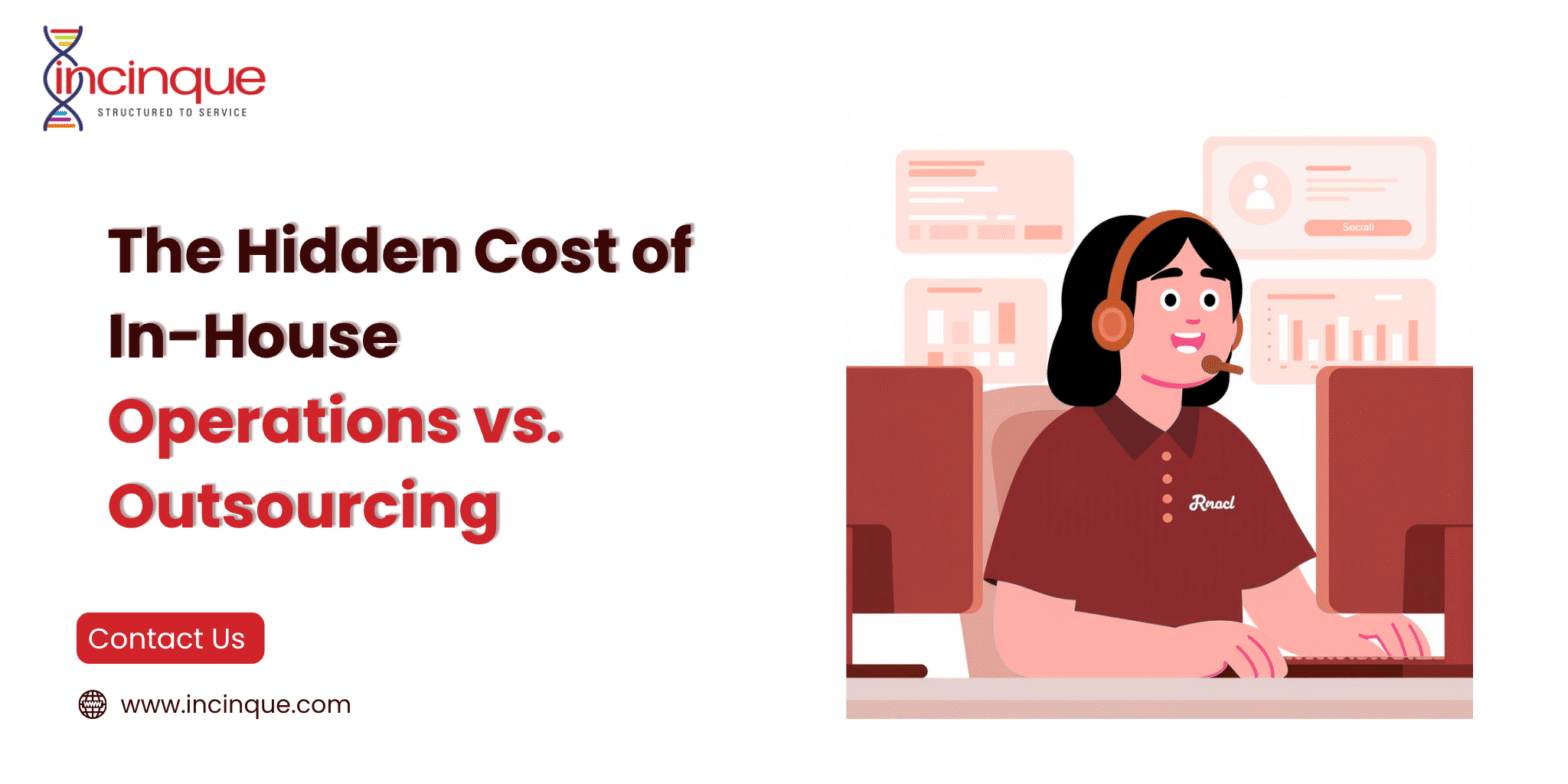
Most business owners who decide to keep operations in-house aren’t making a bad decision, they’re making an incomplete one. They see the outsourcing quote and compare it against the salary of one employee. That math almost always makes in-house look cheaper. The problem is it’s the wrong math.
The real cost of running a team internally goes far beyond the monthly payroll. There are costs that never show up cleanly on a P&L and those are the ones that quietly drain your margins year after year.
What You See vs. What You're Actually Paying
Take a customer support team as an example. You hire five agents at $35,000 a year each. On paper, that’s $175,000 annually. But run through the full picture:
Employer-side payroll taxes add roughly 7–10% on top of every salary. Benefits, such as health insurance, paid leave, sick days, can push another 20–30%. Then there’s office space, hardware, software licences, and IT infrastructure.
Before you’ve placed a single call, that $175,000 team is probably costing you $250,000–$280,000. And that’s before anyone quits.
Turnover: The Cost Nobody Budgets For
Staff attrition is one of the most expensive things that can happen to an operations team, and it happens constantly. In customer-facing and back-office roles, annual turnover rates of 25–40% are not unusual.
Each departure triggers a cycle: job postings, HR time, interviews, background checks, notice periods, onboarding, and three to six months before the replacement is actually productive. Research in this area consistently puts replacement costs at 50–200% of an employee’s annual salary, depending on the role.
Outsourcing partners absorb this entirely. When a member of their team leaves, it’s their problem to solve, not yours. Your service levels don’t dip. Your managers don’t spend a week re-interviewing.
Management Bandwidth Is Not Free
Every hour your senior leadership spends managing an in-house operations team is an hour not spent on growth, product, or client relationships. This opportunity cost almost never gets quantified in the build-vs-buy conversation.
Performance reviews, shift scheduling, compliance training, conflict resolution, these are real time sinks. A mid-sized in-house ops team can consume 15–20 hours of management attention per week. Price that at your leadership’s effective hourly rate and the number becomes sobering.
Scaling Cuts Both Ways
In-house operations are expensive to scale up and even more expensive to scale down. If you win a big contract and need double the capacity in 30 days, you’re looking at a hiring crunch that will almost certainly result in rushed decisions and undertrained staff.
If that contract ends six months later, you’re overstaffed and facing difficult conversations. Severance, legal exposure, and morale damage to the team that stays, and none of this appears in the original cost model.
Outsourcing lets you flex capacity without absorbing headcount risk. You pay for what you use, and you adjust as business conditions change.
So When Does In-House Actually Win?
There are functions where internal teams genuinely make sense — typically those tied to your core product, proprietary IP, or company culture. Senior strategy, product development, and executive leadership are rarely good outsourcing candidates.
But routine, process-driven functions like demand generation, customer support, logistics coordination, quality assurance, back-office processing, are exactly where outsourcing partners earn their keep. These are repeatable processes that specialist teams are built to run efficiently at scale.
The Honest Calculation
Before your next “let’s keep it in-house” decision, run the real numbers: salary, plus payroll taxes, plus benefits, plus infrastructure, plus turnover costs, plus management time. Then compare that against what a specialist outsourcing partner charges, and what they bring in expertise, scalability, and accountability.
Most businesses that do this exercise don’t abandon internal teams entirely. But they do stop treating outsourcing as a cost, and start treating it as the leverage it actually is.
If your operations are costing more than they should, now’s a good time to explore what’s possible. Reach out to Incinque Business Solutions, the conversation is free.